


Yes, you can head into Vermont’s Green Mountain National Forest, find your own Christmas tree and legally cut it down for $5.
And if your family is up for a little more adventure than walking through the rows of a Christmas tree farm, this might be one of the best ways to get your tree in Vermont.
Instead of arriving at a farm and choosing from carefully shaped balsams and Frasers, you’re heading into the actual forest. You’ll need to figure out where you’re allowed to cut, bring your own saw, walk until you find your tree and get it back to your car yourself.
Your tree probably won’t be perfectly symmetrical. You might walk farther than you expected. There may be snow. The roads may not be plowed. Cell service may disappear.
That’s also the point.
For $5, you get your Christmas tree and an excuse to spend a December morning outside in the Green Mountains.
Here’s exactly how it works.
First: You Need a $5 Christmas Tree Permit
The U.S. Forest Service allows you to harvest a Christmas tree from designated areas of the Green Mountain National Forest with a Christmas tree permit.
The permit costs $5 per tree, plus a $2.50 Recreation.gov reservation fee when purchased online. The current Green Mountain National Forest permit allows up to two permits per household per year.
You can purchase and print your permit online through Recreation.gov before heading into the forest.
Purchase a Green Mountain National Forest Christmas Tree Permit
And here’s a great option for families with fourth graders: children with an Every Kid Outdoors Pass are eligible for a free Christmas tree permit. The online reservation fee still applies.
You Can’t Cut a Tree Just Anywhere
This is probably the most important part to understand before heading out.
Buying a permit doesn’t mean you can pull over anywhere in the Green Mountain National Forest and start looking for a tree.
The Forest Service provides downloadable maps showing where Christmas tree cutting is allowed, including maps for the individual ranger districts. There are also georeferenced versions that can be used with mapping apps such as Avenza.
There are several places where your permit is not valid, including congressionally designated wilderness areas, active timber sale areas and developed recreation sites such as campgrounds, picnic areas and day-use areas. And you absolutely cannot cut a tree on private property.
Download your map before leaving home.
Cell service can be unreliable or nonexistent in parts of the National Forest, and the Forest Service specifically recommends bringing a map rather than relying entirely on GPS.
So How Do You Find Your Christmas Tree?
This part is considerably different from walking into a Christmas tree farm.
There aren’t neat rows of uniformly shaped trees waiting for you.
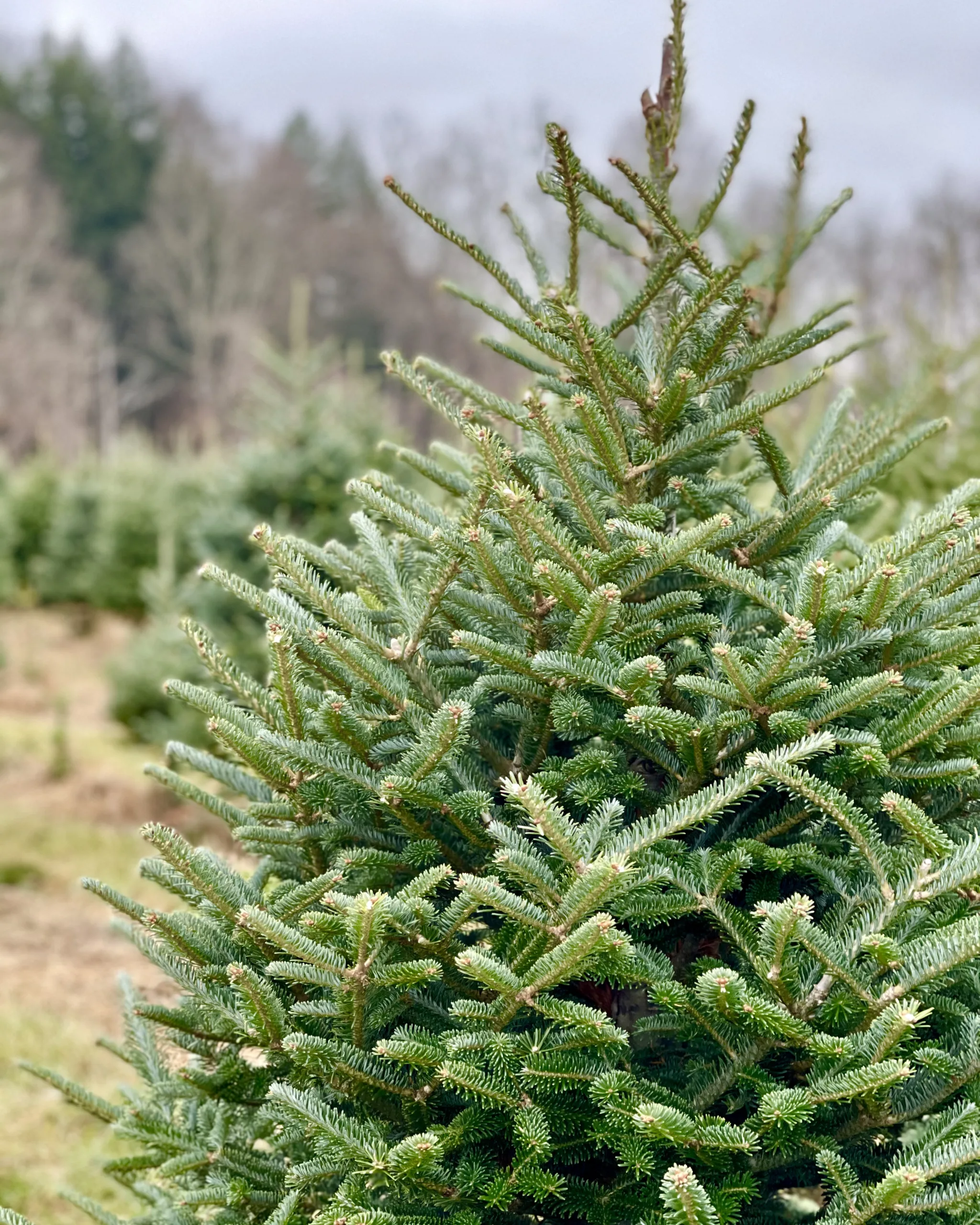
You’re looking for a naturally growing evergreen in the forest.
The Forest Service actually recommends looking in a densely forested area. Removing a smaller tree from an overcrowded stand gives the trees left behind more room to grow. Christmas tree harvesting in designated areas can therefore contribute to forest management rather than simply removing a tree for the holidays.
Walk around. Look at trees from multiple sides. And remember that a tree that looks relatively small outside can become enormous once you get it into your living room.
Measure your ceiling before you leave home.
Seriously.
There Are Rules About the Tree You Choose
Under the current Green Mountain National Forest permit rules, your Christmas tree can be no more than 20 feet tall.
Once you’ve chosen it, you need to cut the entire tree. You can’t simply remove the top of a larger tree.
The stump you leave behind must be no more than six inches high. If there’s snow on the ground, clear the snow away from the base before cutting so you can see where the ground actually begins.
You’re also required to harvest the tree by cutting it. Digging up and transplanting a tree isn’t allowed under the Christmas tree permit, and trees harvested with these permits cannot be resold.
What Should You Bring?
This is not the day to show up with nothing but a cute winter outfit and hope for the best.
At minimum, I’d bring:
- Your printed permit
- The appropriate cutting-area map
- A handsaw
- Measuring tape
- Warm, waterproof boots
- Gloves
- Layers and extra dry clothing
- A tarp
- Rope or proper vehicle straps
- Water and snacks
- A shovel if there’s snow
- A fully charged phone
- More winter gear than you think you’ll need
The Forest Service also recommends considering tire chains, a tow chain and a shovel because Forest Service roads may not be plowed. Make sure you have plenty of gas before heading in.
This isn’t a Christmas tree lot. You’re heading into the National Forest in Vermont in late November or December, and conditions can change quickly.
Make the Search Part of the Experience
This is probably the biggest reason I’d choose the National Forest option at least once.
You’re not just buying a Christmas tree.
You’re going for a walk in the woods in December with an actual mission.
Bring your kids. Bring friends. Pack a thermos of something hot. Give yourself a few hours instead of trying to squeeze the trip between errands.
Let everyone nominate a tree.
Debate whether it’s too tall.
Walk another quarter mile because someone is convinced there’s a better one ahead.
Eventually realize the tree you passed 20 minutes ago was probably the one.
That’s the experience.
And in a season when it’s very easy to spend an entire weekend shopping, driving from place to place and working through a December to-do list, I love that this forces you to spend a few hours outside instead.
Your $5 Tree Can Actually Help the Forest
Cutting down a tree and helping the forest may sound contradictory, but there’s a reason the Forest Service runs this program.
The Forest Service encourages permit holders to select trees from densely populated stands. Removing appropriately sized trees from these areas can give the remaining trees more room to grow. Nationally, the Christmas tree permit program is used in areas where thinning smaller-diameter trees can support forest management.
You’re not being invited to remove old or significant trees from anywhere you’d like.
You’re being given permission to harvest a relatively small tree from specific areas under specific rules.
Follow those rules, choose from an appropriate dense stand and leave everything else as you found it.
Getting Your Tree Back to the Car
Finding the tree may be the fun part.
Getting it back out is where you’ll be glad you planned ahead.
The Forest Service recommends carrying the tree rather than dragging it because dragging can remove needles and damage the bark. A tarp can also help with moving it.
Consider how far you’re willing to carry a six-, eight- or ten-foot evergreen before walking miles from your vehicle.
Once you reach the car, secure it properly with rope or straps. If you’re transporting it somewhere exposed to the wind, the Forest Service recommends wrapping the tree in canvas to help prevent wind damage.
And don’t forget where you’ve parked.
That sounds obvious until you’re standing in a snowy National Forest where every bend in the road suddenly looks exactly the same.
A Few Winter Safety Things That Actually Matter
Check the weather and road conditions before leaving home. Start early enough that you’re comfortably back at your vehicle before dark.
Tell someone where you’re going and when you expect to return.
Don’t assume your phone will work.
Don’t block Forest Service gates or roads when you park.
And don’t assume a road that appears on your map will be plowed simply because you can drive it during the summer. These are all recommendations included in the Forest Service’s trip-planning guidance for Christmas tree permit holders.
If the weather or road conditions don’t look good, pick another day.
The tree will wait.
Once You Get Your Tree Home
When you get home, make a fresh cut across the bottom of the trunk and get the tree into water.
If you’re not bringing it inside immediately, store it outdoors somewhere protected from wind, ideally on the north or east side of your house or in another shaded, protected location.
And prepare yourself for the fact that your National Forest tree may not look like the one you would have chosen from a tree farm.
Maybe there’s a gap on one side. Maybe the branches aren’t perfectly spaced.
Maybe the top does something strange. Put that side toward the wall.
You walked into the Green Mountain National Forest and came home carrying your Christmas tree. I think that earns it a little forgiveness.
Is Cutting a Christmas Tree in the Green Mountain National Forest Worth It?
If what you want is the easiest possible way to get a Christmas tree, probably not.
Go to one of Vermont’s excellent Christmas tree farms. You’ll have beautifully maintained trees, easier access and, depending on the farm, everything from cocoa and wreaths to horse-drawn rides.
But if you’re looking for a December adventure that costs $5 and gets you outside for a few hours, buy the permit.
Download the map.
Pack the saw. Fill the thermos. And go find your Christmas tree in the Vermont woods. Just remember: the imperfect one might make the better story.




Talk with locals
Comments
Be the first to chime in
Been here? Your tip could save the next visitor a wrong turn.