

Just when you think Vermont’s fall foliage season couldn’t possibly get any more beautiful, Mother Nature occasionally delivers something even more extraordinary: snowliage.
It’s one of my favorite natural phenomena to witness in Vermont, when the first snowfall of the season blankets the mountains while the valleys below are still bursting with vibrant reds, oranges and golds. Two seasons colliding in one landscape, creating a contrast that’s almost hard to believe is real.
I’ve been fortunate enough to experience snowliage a few times, including one particularly memorable scene in Underhill, Vermont, when Mount Mansfield was covered in fresh snow while the trees at lower elevations were still holding onto their brilliant fall colors. More recently, I’ve spotted similar conditions driving through Vermont’s Northeast Kingdom and New Hampshire’s White Mountains.
It’s one of those fleeting moments in nature that makes me grateful to live somewhere with four distinct seasons, and where the transition between them can be every bit as beautiful as the seasons themselves.

What Is Snowliage?
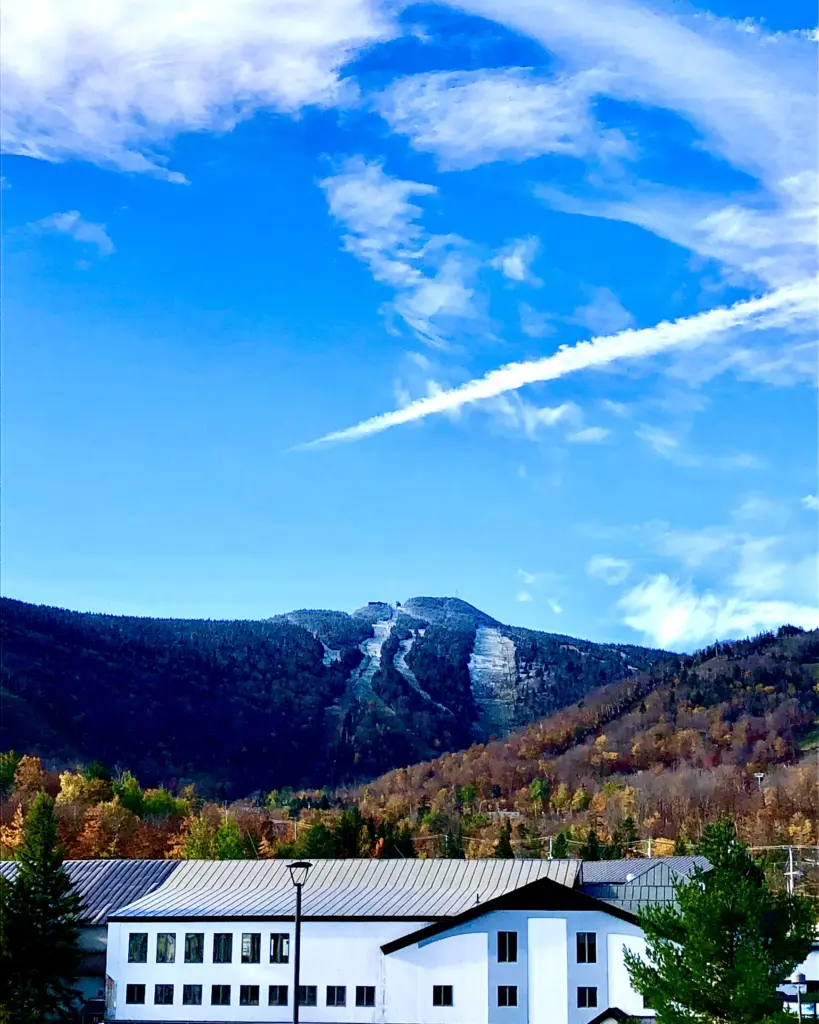
Snowliage is the unofficial term for the natural phenomenon that occurs when fresh snowfall and fall foliage overlap, creating a landscape where snow-covered mountains rise above colorful autumn forests.
The word combines “snow” and “foliage,” and while it’s not an official meteorological term, it’s become a popular way to describe one of New England’s most visually striking seasonal transitions.
Unlike a typical autumn snowfall, where snow may temporarily coat colorful leaves, the most dramatic snowliage happens when higher elevations receive accumulating snow while lower elevations remain relatively warm and retain their fall color.
The result? White mountain summits towering above hillsides filled with fiery reds, brilliant oranges and golden yellows. It’s the best of fall and winter, all in one view.
Why Does Snowliage Happen?
Snowliage is the result of several weather and seasonal conditions lining up at just the right time.
Fall foliage develops at different rates depending on elevation, with trees at higher elevations generally changing color and dropping their leaves earlier than those in the valleys. At the same time, temperatures decrease as elevation increases, meaning Vermont’s mountain summits can experience freezing temperatures and snowfall while nearby towns are still enjoying relatively mild autumn weather.
When an early-season storm moves through during peak foliage, precipitation may fall as snow in the mountains and rain at lower elevations. If enough snow accumulates and the clouds eventually clear, the contrast can be spectacular.
For particularly impressive snowliage, a few things need to happen:
- Peak or near-peak fall foliage: Lower-elevation trees need to be holding onto their vibrant autumn colors.
- An early mountain snowfall: Temperatures must be cold enough for snow to accumulate at higher elevations.
- A significant elevation difference: Mountains and valleys create the dramatic separation between winter white and autumn color.
- Good visibility: Once the storm clears, the snow-covered peaks become visible above the colorful landscape.
Timing is everything. Snow can melt quickly during October, and strong winds or heavy precipitation can strip leaves from the trees. Sometimes the most beautiful snowliage conditions last only a few hours.

Where Can You See Snowliage in Vermont?
Vermont’s mountainous terrain makes it an especially good place to experience snowliage, particularly in regions where high peaks rise above valleys that hold their foliage later into the season.
Mount Mansfield and Underhill
One of my most memorable snowliage experiences was in Underhill, looking toward Mount Mansfield, Vermont’s highest mountain. The summit was blanketed in fresh snow while the surrounding landscape remained rich with autumn color.
With its dramatic elevation change and expansive views, Mount Mansfield is an excellent place to watch for early-season snow above colorful forests. The Stowe and Underhill sides of the mountain can offer particularly beautiful perspectives.
Smugglers’ Notch and Stowe
The mountains surrounding Smugglers’ Notch can create striking snowliage conditions when early snowfall reaches the higher peaks. Depending on road conditions and seasonal closures, views from the surrounding valleys and lower elevations can be especially rewarding.
Vermont’s Northeast Kingdom
The Northeast Kingdom is another region where I’ve encountered snowliage, particularly while driving through the more mountainous areas around Burke and the northern Green Mountains.
The combination of open countryside, mountain views and colorful forests can make for spectacular scenery when an early snowfall arrives.
The Green Mountain National Forest
Central and southern Vermont can also experience snowliage, particularly around higher elevations near Killington, Mount Ellen and other Green Mountain peaks. Because foliage often progresses later in parts of Southern Vermont, there’s sometimes an opportunity for early mountain snow to coincide with colorful leaves at lower elevations.
And while it’s not Vermont, New Hampshire’s White Mountains are another incredible place to look for this phenomenon. I’ve seen beautiful snowliage conditions there while traveling through New England during October.
When Is the Best Time to See Snowliage?
In Vermont, snowliage is most likely to occur during October, when fall foliage and the possibility of early mountain snowfall overlap.
But unlike peak foliage, which follows a somewhat predictable seasonal progression, snowliage isn’t something you can reliably plan a trip around. It depends entirely on weather conditions, elevation and how much color remains on the trees.
The best opportunity often comes immediately after an early-season mountain snowstorm, especially when the skies clear and the fresh snow is still visible.
My advice? Keep an eye on the mountain forecasts during foliage season, particularly when colder temperatures and precipitation are expected. You might wake up to find the mountains looking completely different from the day before.
And remember, the best views aren’t necessarily from the summit. In fact, I think snowliage is often most beautiful from lower elevations, where you can appreciate the contrast between the colorful foreground and snow-covered peaks in the distance.
Why Snowliage Is One of Vermont’s Most Beautiful Natural Phenomena
I’ve experienced more than a decade of Vermont fall foliage seasons, and I’m still amazed by how different each year can be. Some years bring particularly vibrant reds, others are dominated by golds, and occasionally we get the added surprise of snowliage.
What makes it so special isn’t just the contrast in colors. It’s the opportunity to witness two seasons at once, with autumn still unfolding in the valleys while winter makes its first appearance in the mountains.
It’s also a reminder of how quickly our landscape changes. The snow may disappear by afternoon, the leaves may fall in the next storm, and the scene you witnessed that morning may never look quite the same again.
For me, that’s part of the appeal of exploring Vermont. You can drive the same backroad dozens of times and still encounter something entirely unexpected.
Snowliage is one of those moments that makes me pull over, get out of the car and simply appreciate what’s in front of me. No elaborate itinerary required. Just a little luck, the right weather conditions and the willingness to take the scenic route.
Have you ever experienced snowliage in Vermont or elsewhere in New England? It’s one of nature’s most beautiful collisions of seasons, and something I hope every fall foliage enthusiast gets to witness at least once.






Talk with locals
Comments
Be the first to chime in
Been here? Your tip could save the next visitor a wrong turn.