

A covered bridge is usually enough to persuade me to take a detour. Add a river and a drive through Southern Vermont, and I’m very easily convinced.
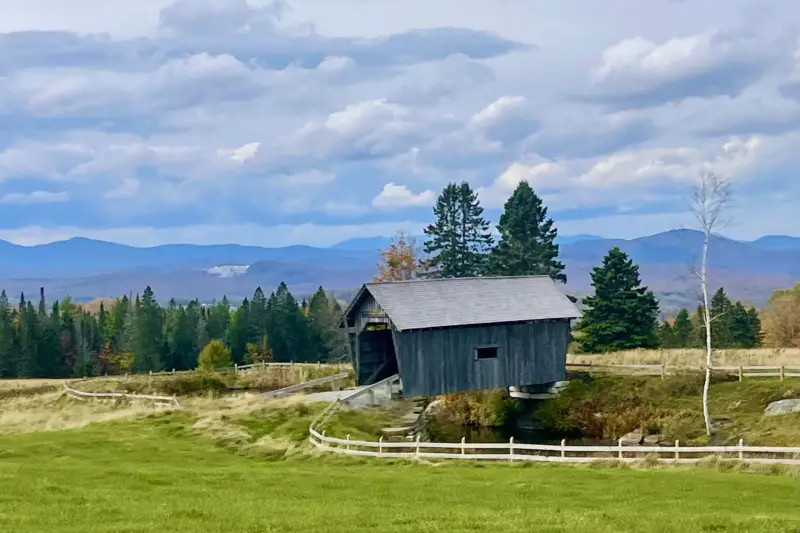
If you’re exploring Newfane, put the Williamsville Covered Bridge on your route. It carries Dover Road across the Rock River, away from the village green and the traffic on Route 30. It’s a quick stop, but a good reason to see a little more of the town than you would from the main road.
The name can cause some confusion if you’re searching for “the Newfane covered bridge.” Williamsville is part of the town of Newfane, so searching for Williamsville Covered Bridge will get you to the right place.


Where to Find It
The bridge is on Dover Road, between Williamsville and South Newfane. From Route 30, take Williamsville Road toward Williamsville, then follow Dover Road toward South Newfane. A covered-bridge preservation organization lists the approach as roughly two miles along Williamsville Road, followed by about six-tenths of a mile on Dover Road.
I’d enter the bridge’s name into your map before setting out rather than simply navigating to Newfane village. That will save you from arriving at the courthouse and wondering where someone has managed to hide a river crossing.
This is a working road, so take your time approaching and follow the posted signs. If you want to stop for photos, find a legal place completely clear of the roadway first.
An Old Crossing With a Newer Bridge
The history here needs a little explanation, because the covered bridge you see today was built in 2010.
Its predecessor was a nineteenth-century bridge that had been repaired and reinforced over the years. Accounts differ on its exact construction date, with some placing it around 1870 and others noting that it may have existed before the flood of 1869. It was the last of the seven covered bridges that once stood in Newfane.
Eventually, the old structure could no longer meet modern traffic needs, including carrying emergency vehicles. After years of discussion, the town chose a replacement covered bridge modeled on the original.
The old bridge was removed in July 2010, and the new span was placed over the river that August. The replacement retained the Town lattice design, with its crisscrossing wooden framework, and a length of about 118 feet.
I like knowing that story before visiting. It gives you more to think about than the age of the timbers: this is a place where the town chose to keep a covered bridge as part of an everyday route.
Why Make the Stop?
For me, the appeal is the combination of the bridge and the drive to get there. A short detour becomes a chance to follow the river valley and see another part of Newfane.
It also fits easily into a larger Southern Vermont outing. Spend time around Newfane village, stop at Bensch Mountain Maple on Route 30, and leave room for whatever catches your attention along the way. You don’t need a full day devoted to covered bridges to include one in your plans.
Just remember that people use this crossing to get where they’re going. Enjoy the view and take your photos from a safe spot, then let the bridge get back to doing its job.
What to Know Before You Go
- Location: Dover Road over the Rock River, between Williamsville and South Newfane, within the town of Newfane, Vermont.
- Map search: Use “Williamsville Covered Bridge” rather than navigating to Newfane village.
- Cost: No admission fee.
- How long to allow: About 10 to 20 minutes if you find a suitable place to stop and park off the road.
- Driving: This is an active vehicle crossing. Follow posted clearance, weight and traffic signs.
- Parking: Don’t assume there is a dedicated visitor lot. Stop only where legal and completely clear of traffic, driveways and bridge approaches.
- Photography: Stay aware of approaching vehicles and avoid standing in the travel lane.
- Seasonal tip: Check road conditions in winter and after severe weather, especially if you’re continuing onto smaller roads.





Talk with locals
Comments
Be the first to chime in
Been here? Your tip could save the next visitor a wrong turn.