


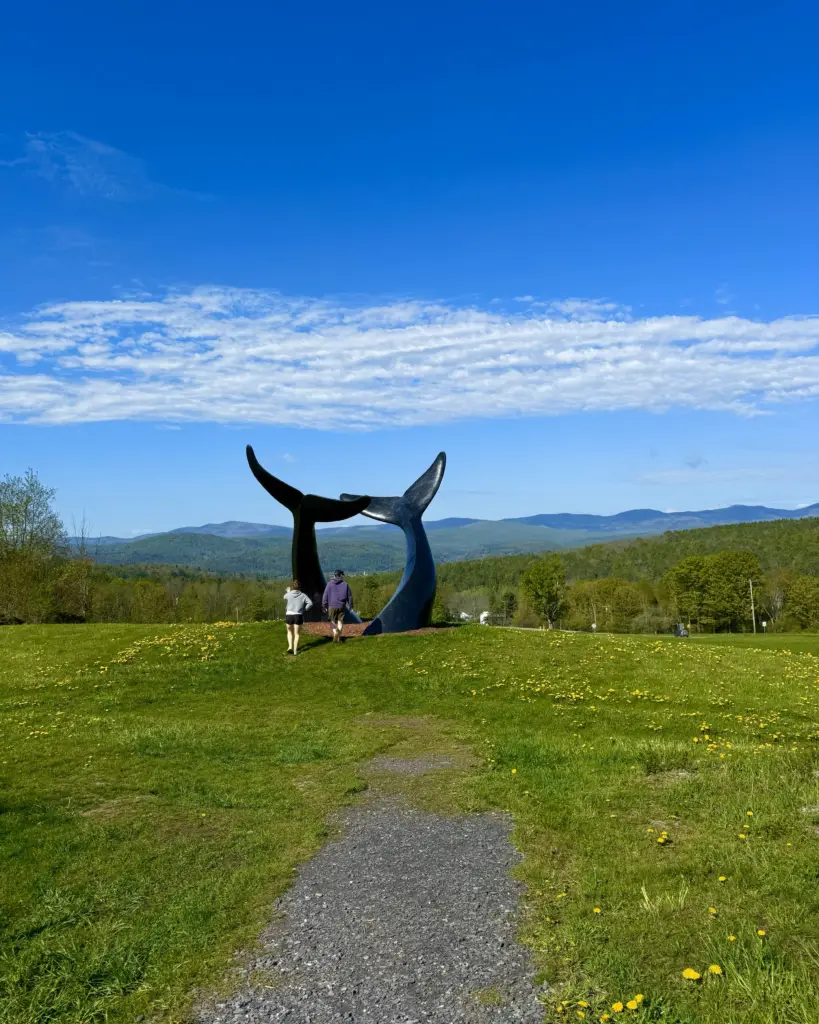
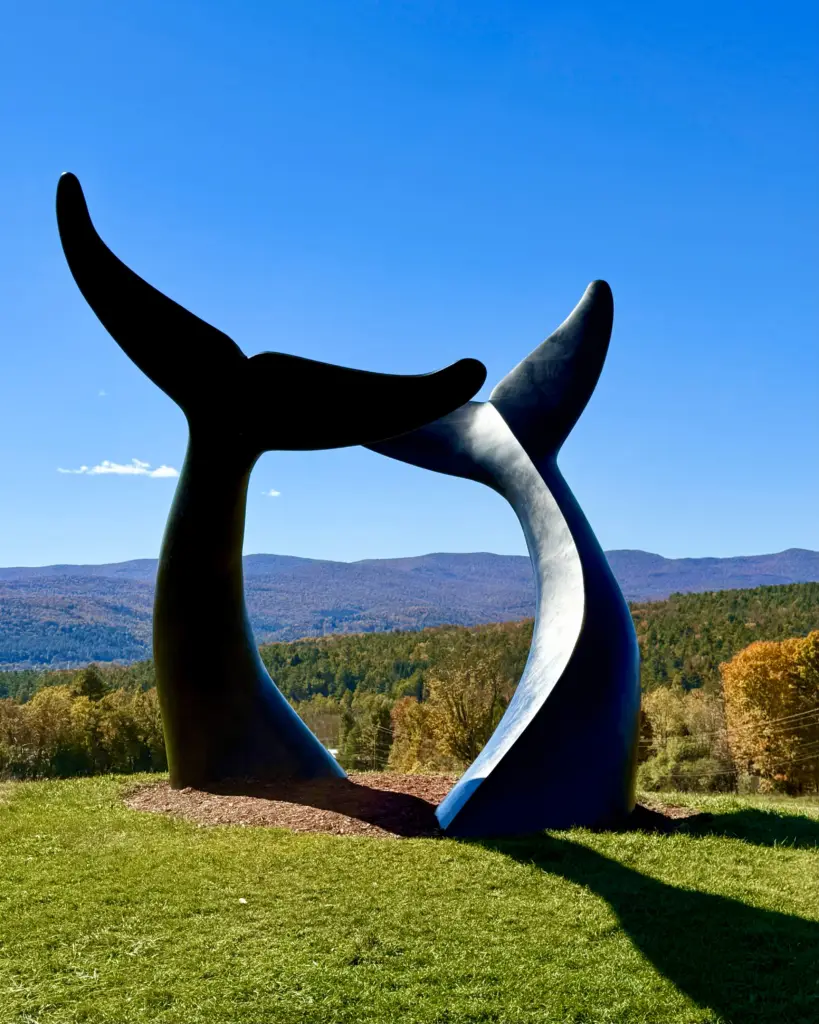
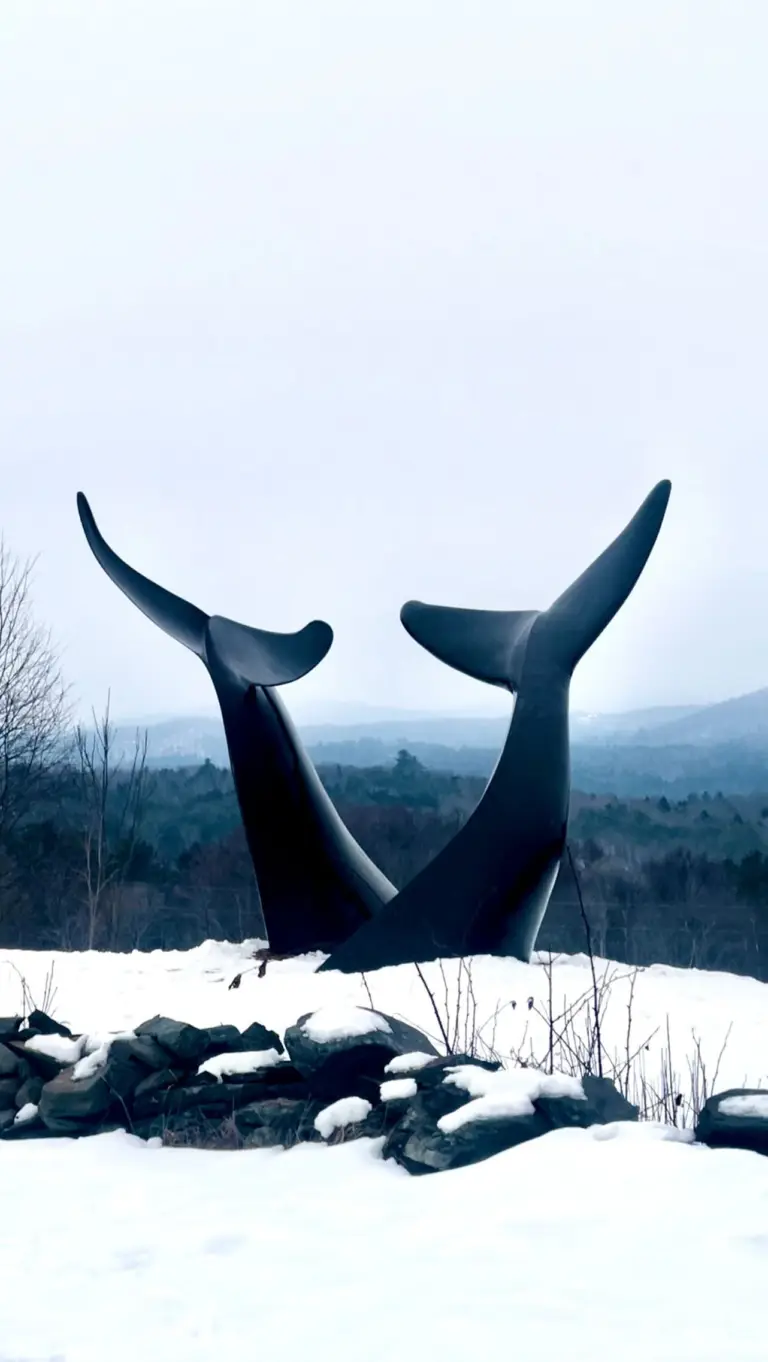
If you spot enormous bronze whale tails rising from a hillside near I-89 Exit 4 in Randolph, you’re actually looking at the second chapter of one of Vermont’s most recognizable roadside attractions.
These are Whale Dance, created by Vermont sculptor Jim Sardonis and installed in 2019. They’re big, dramatic and hard to miss from the interstate, but their location isn’t random. More than 30 years earlier, this same hillside was home to another Sardonis sculpture: the black granite whale tails now standing at Technology Park in South Burlington.
Those original whales left Randolph in 1999.
It took 20 years, a major conservation effort and another commission for whales to return to the hillside, and when they finally did, Sardonis didn’t simply recreate what had been there before. He gave Randolph an entirely new set of the famed Whale Tails.

Before Whale Dance, Randolph Had Reverence
The story begins in 1989, when Sardonis created Reverence, a sculpture featuring two enormous whale tails carved from approximately 36 tons of African black granite.
The sculpture was installed on a hillside near I-89 Exit 4 in Randolph, where the dark granite tails appeared to be disappearing beneath an imaginary sea of grass. For travelers on the interstate, the whales quickly became a landmark and an easy way to recognize exactly where you were on the drive through central Vermont.
Then the property changed hands.
In 1999, Reverence was sold and relocated approximately 50 miles north to Technology Park in South Burlington. The sculpture found a prominent new home beside I-89, where it remains today and has become one of the Burlington area’s most recognizable pieces of public art.
Randolph was left without its whales. And apparently, people missed them.
How Randolph Got Its Whale Tails Back
The land surrounding the original Reverence site remained important even after the sculpture left. Over the following years, conservation efforts focused on protecting the prominent hillside near Exit 4 from development and preserving the landscape that so many travelers associated with the original whales.
Those efforts eventually helped make it possible for Jim Sardonis to return to the site with a new commission of Whales Tails.
Rather than recreating Reverence, Sardonis designed an entirely new sculpture that could acknowledge what had once stood here while becoming its own piece of art.
The result was Whale Dance.
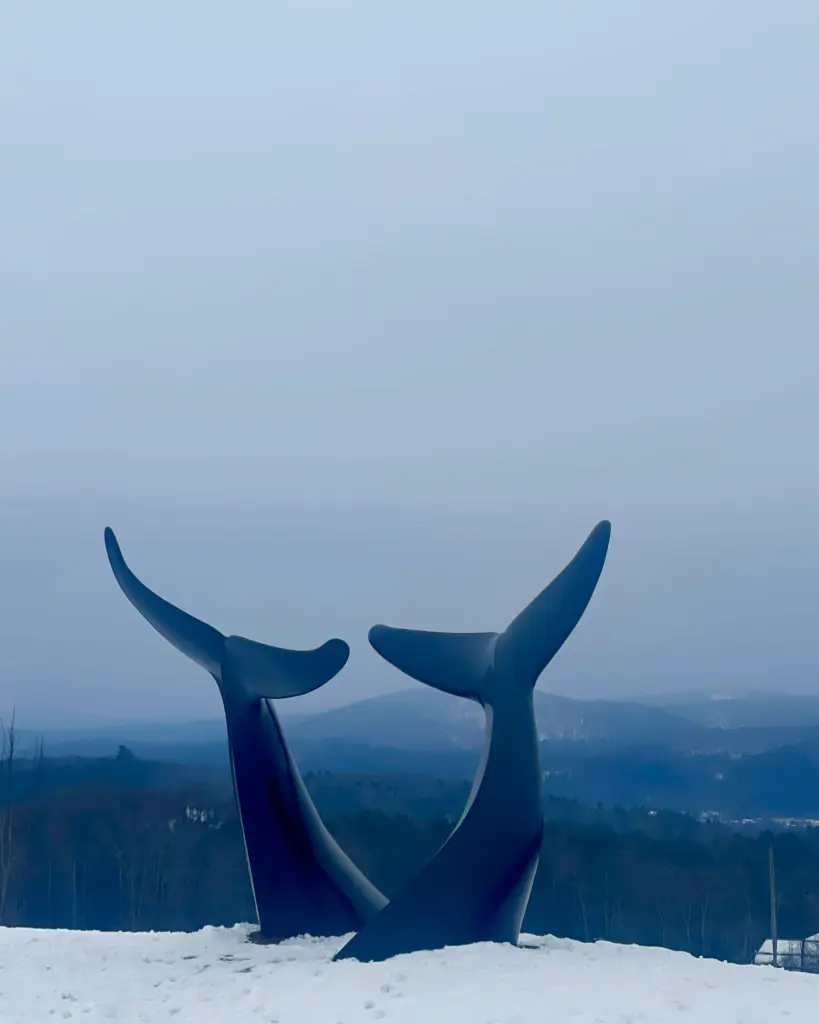
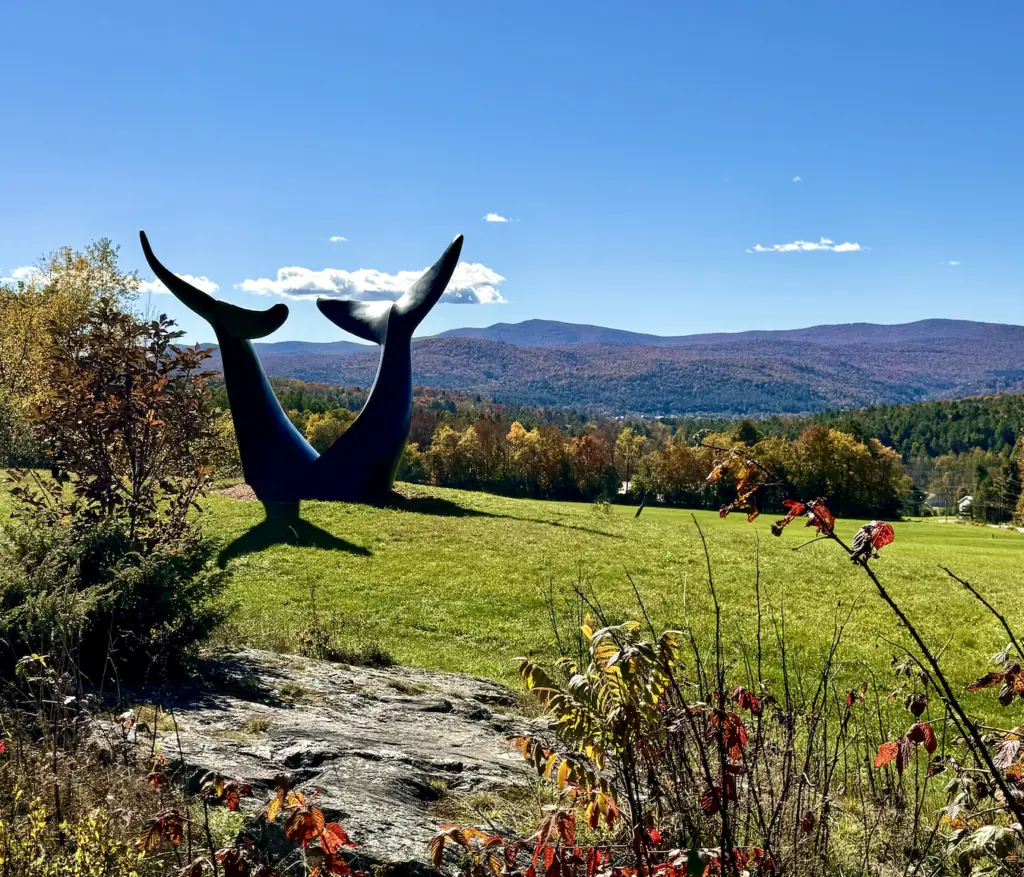
Installed in 2019, the bronze sculpture returned whales to the Randolph hillside two decades after Reverence had departed. The new work is larger and more dynamic than its predecessor, but the connection between the two is unmistakable.
It’s almost as though the whales migrated north and then, eventually, some came back.
Whale Dance Isn’t a Replica of Vermont’s Original Whale Tails
If you’ve seen the black granite tails in South Burlington, don’t expect to find a duplicate when you arrive in Randolph.
Whale Dance is very much its own sculpture.
Where Reverence uses two polished black granite tails to create the quiet illusion of whales diving beneath a grassy sea, Whale Dance is cast in bronze and has a much more active sense of movement. Sardonis revisited the whale imagery decades after creating the original sculpture, but he interpreted it differently rather than simply recreating his earlier work.
That makes visiting both sets much more interesting. South Burlington has the original. Randolph has the return. Together, they tell a story that has unfolded along I-89 for more than three decades.
Why Whale Tails in Vermont Actually Make Sense
Of course, both sculptures raise the same obvious question: why whales?
Vermont isn’t exactly known for its coastline, but the state has a fascinating prehistoric connection to the ocean.
At the end of the last Ice Age, the enormous weight of glaciers had depressed the land across this region. As the ice retreated, water from the Atlantic Ocean flowed inland and created the Champlain Sea, covering portions of what are now Vermont, New York and Canada.
Marine animals lived here, including whales.
One of the best pieces of evidence was discovered in Charlotte in 1849, when workers building a railroad uncovered the fossilized remains of a beluga whale. The discovery helped demonstrate just how dramatically different Vermont’s landscape looked thousands of years ago.
So while seeing whale tails rising from a hillside in Randolph might initially seem completely random, there’s a deeper connection between these sculptures and the natural history of Vermont.
Whales really did swim here. The interstate came considerably later.

Look for Whale Dance Near I-89 Exit 4
Part of the appeal of Whale Dance is its setting. The whale tails sculpture stands on a prominent hillside near I-89 Exit 4 in Randolph, returning whale imagery to the same general landscape where Reverence became a landmark decades earlier.
If you’ve driven this section of I-89, you may already have spotted the bronze whales without realizing why they’re there. Knowing the history makes the next sighting much more interesting because you’re not simply looking at a strange sculpture beside the highway. You’re looking at the continuation of a story that started on this hillside in 1989.
The land itself is part of that story, too. The preservation of the Exit 4 landscape helped make the return of the whales possible, connecting public art with a broader effort to protect one of Randolph’s most visible open spaces.
See Both Sets of Vermont Whale Tails
This is one Vermont roadside story where I’d actually encourage you to find both halves.
Start with Whale Dance in Randolph and then keep driving north on I-89. Roughly 50 miles later, you’ll reach South Burlington, where Reverence now stands at Technology Park.
Seeing both lets you follow the same path the original sculpture traveled.
In Randolph, you get the landscape where the story started and the bronze whales that eventually brought it full circle. In South Burlington, you can see the original black granite sculpture that started the whole thing.
They’re connected by one artist, one interstate and one very Vermont story about public art, conservation and a community that missed its whales enough to bring them back.
Make Whale Dance Part of Your Next Drive Through Randolph
It’s easy to treat I-89 as simply a way to move between northern and southern Vermont, but Whale Dance is a good reminder to pay attention to what’s sitting just beyond the guardrail.
What looks like an unusual set of bronze whales on a hillside is actually the second chapter of a story that began here decades earlier. The original whales became so closely associated with this landscape that their departure was still being felt years later, eventually inspiring a completely new work from the same artist.
So when you see those enormous bronze tails near Exit 4, know that they aren’t random.
The whales have history here. They left once. And in 2019, they finally came back.
Know Before You Go
- What
- Whale Dance
- Where
- Near I-89 Exit 4 in Randolph, Vermont
- Artist
- Jim Sardonis
- Installed
- 2019
- Material
- Bronze
- Why here
- The site was the original home of Sardonis’ Reverence whale-tail sculpture from 1989 until 1999.
- What happened to the originals
- Reverence was sold and relocated to Technology Park in South Burlington, where it remains today.
- Cost
- Free to see
- Don’t miss
- If you’re traveling north on I-89, continue to South Burlington and see Reverence too. Visiting both gives you the complete story of Vermont’s two sets of whale tails.








Talk with locals
Comments
Be the first to chime in
Been here? Your tip could save the next visitor a wrong turn.