

You don’t have to climb a mountain summit to find some of Vermont’s best winter views.
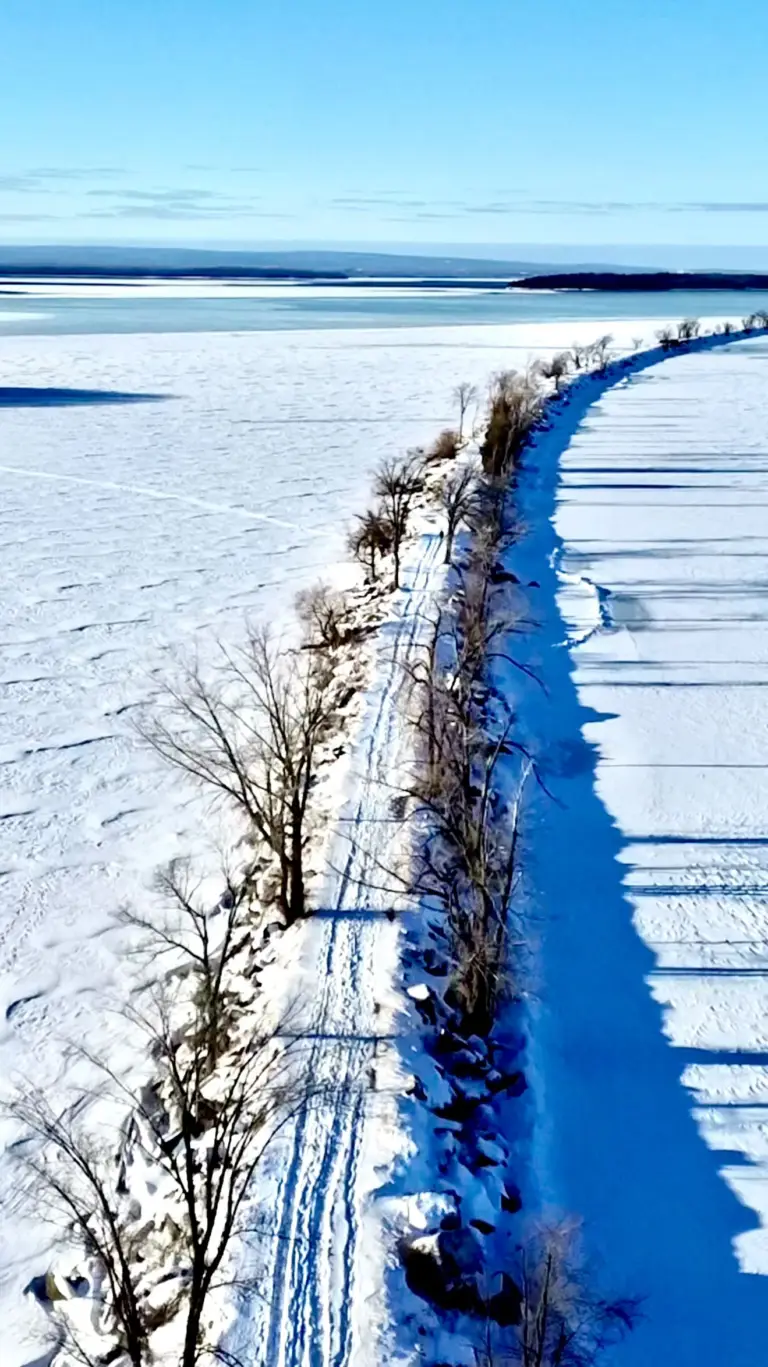
Just outside Burlington, the Colchester Causeway stretches directly into Lake Champlain, creating one of the most unusual places in Vermont to walk, snowshoe or cross-country ski during winter. Instead of gaining elevation, you’re heading farther and farther out onto the lake, surrounded by frozen water, open sky and mountains rising in the distance.
I’ve explored the Causeway during different seasons, but winter completely changes the experience. The summer cyclists and boats disappear, snow covers the narrow path, and Lake Champlain transforms into a vast winter landscape that can make you feel surprisingly far from civilization despite being only a short distance from Burlington.
It’s also proof that experiencing a great Vermont winter view doesn’t always require a strenuous hike.
Sometimes you can just walk toward the middle of the lake.
What Is the Colchester Causeway?
The Colchester Causeway is a narrow pathway extending across Lake Champlain from Colchester toward South Hero and the Champlain Islands.
Originally constructed as part of a railroad route across the lake, the old railbed has since been transformed into one of the most recognizable sections of the Island Line Trail. During warmer months, it’s particularly popular with cyclists, walkers and runners, with the seasonal Local Motion Bike Ferry helping people cross “the Cut,” a gap in the Causeway that allows boats to pass through.
Winter is a completely different experience.
The bike ferry isn’t running, and you won’t be able to continue across the Cut the way cyclists do during the warmer months. Instead, the Causeway becomes an out-and-back winter adventure where the journey itself is the reason to go.
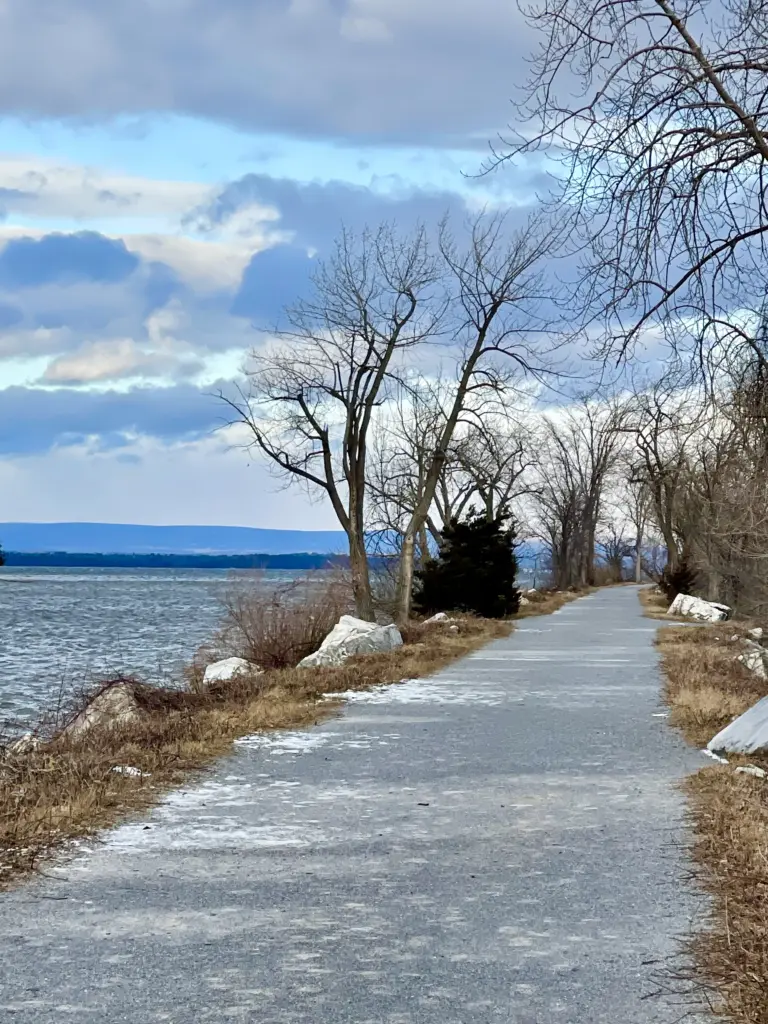
With the lake stretching away on both sides of the narrow trail, you can look west toward New York’s Adirondacks and east toward Vermont’s Green Mountains. On a clear winter day, the combination of frozen water and distant peaks creates a perspective that’s difficult to find anywhere else around Lake Champlain.
Why Visit the Colchester Causeway in Winter?
There are plenty of places to hike for a mountain view in Vermont, but the Causeway gives you something entirely different.
You’re essentially walking out into the middle of the landscape you’re there to see.
Rather than following a forest trail until you finally reach an overlook, the views begin opening almost immediately as you move farther onto the Causeway. The shoreline gradually recedes behind you, the mountains become more prominent and the lake takes over your field of vision.
Winter makes the scale of Lake Champlain feel even more dramatic. Depending on conditions, you may see stretches of ice, snow, dark open water or some combination of all three. The scenery can look completely different from one visit to another, which is one of the reasons I think it’s worth returning throughout the season.
There are no motorized vehicles on the Causeway, either, so once you get beyond the busier access points, the experience becomes remarkably quiet.
Walk, Snowshoe or Cross-Country Ski the Causeway
You don’t need specialized equipment to experience the Colchester Causeway in winter, but what you bring should depend on the conditions.
After packed snow or during relatively clear stretches, walking may be all you need. When there’s deeper snow, snowshoes can make the trip considerably easier, while cross-country skis turn the long, mostly level route into a completely different kind of adventure.
Traction can also be useful when packed snow becomes icy, so I like having microspikes available even if I don’t end up needing them.
One of the best parts of the Causeway is that you don’t have to commit to a specific distance. Because you’re heading out and returning along the same route, you can simply walk until you’ve had enough of the views, wind or cold and then turn around.
Just remember that however far you go out, you still need to cover that same distance on the way back.
Prepare for the Wind on Lake Champlain
The Colchester Causeway may be relatively flat, but don’t confuse that with an easygoing winter walk in every condition.
The biggest factor is exposure.
Once you’re out on the Causeway, there’s very little protecting you from wind moving across Lake Champlain. A winter day that feels manageable on land can become significantly colder once you’re surrounded by open lake, particularly when the wind picks up.
I recommend dressing more conservatively than you think you’ll need. Warm layers, a wind-resistant outer shell, insulated boots, gloves and a hat can make the difference between enjoying the scenery and immediately wondering why you left your car.
I’d also check the weather before heading out, paying attention to wind conditions in addition to temperature. Vermont winter weather can change quickly, and an exposed path across Lake Champlain isn’t where I’d want to discover that the forecast has taken a turn.
And while the Causeway itself provides the route, don’t assume surrounding lake ice is safe simply because it looks frozen. Stay on the established trail rather than venturing onto the ice.
Go at Golden Hour for an Incredible Winter View
If conditions cooperate, late afternoon is my favorite time to experience the Colchester Causeway in winter.
As the sun begins dropping toward the Adirondacks to the west, the light stretches across Lake Champlain and changes the entire landscape. Snow and ice can pick up shades of gold and pink while the mountains become darker against the horizon, and on particularly clear days, you can see an enormous stretch of the Champlain Valley around you.
It’s one of those Vermont views where the openness is just as impressive as the mountains.
There’s also something different about watching the sun lower while you’re standing out on the Causeway rather than seeing it from the shoreline. With the lake on both sides, you’re surrounded by the changing light rather than simply looking toward it.
If you’re planning a golden-hour walk, though, keep track of how far you’ve traveled and leave yourself enough time to get back before dark. Winter sunsets arrive early in Vermont, and temperatures can drop quickly once the sun disappears.
A Winter Adventure Without the Mountain Climb
One of the reasons I recommend the Colchester Causeway is that Vermont’s outdoor experiences don’t all need to involve climbing something.
Winter hiking is wonderful, but not everyone wants to spend several hours gaining elevation to reach a summit, especially when snow, ice and short daylight hours make mountain hikes more complicated.
The Causeway offers another option.
You can spend an hour walking, bring snowshoes after a storm or turn it into a longer cross-country ski, all while getting expansive views that would normally make you think you’d climbed much higher.
It’s accessible on your own terms, too. There isn’t a summit you have to reach for the outing to feel complete. Walk as far as you want, stop to take in the Adirondacks and Green Mountains, then turn around when you’re ready.
The view is the experience.
Add the Colchester Causeway to Your Vermont Winter List
If you’re looking for a winter adventure near Burlington that doesn’t involve a ski resort or mountain summit, put the Colchester Causeway on your list.
Bundle up, check the wind, bring traction if conditions call for it and give yourself enough time to wander without rushing. If you can time your visit for a clear late afternoon, even better.
Then start walking toward Lake Champlain.
The farther you go, the more the shoreline falls away and the bigger the winter landscape becomes, until you’re standing between two mountain ranges with frozen Lake Champlain stretching around you.
Some of Vermont’s best winter views require climbing thousands of feet.
This one just asks you to keep walking.






Talk with locals
Comments
Be the first to chime in
Been here? Your tip could save the next visitor a wrong turn.